
How to Help a Toddler Pedal a Bike: Step-by-Step Guide
Quick Answer
To help a toddler pedal a bike, start with a properly fitted bicycle or tricycle and demonstrate how the pedals move. Practice on a flat surface, teach your child to push each pedal forward, and provide gentle support. Gradually reduce assistance as your toddler develops coordination, confidence, and independent pedaling skills.
- Choose a bike that fits your toddler comfortably.
- Demonstrate the forward pedaling motion.
- Practice starting with one pedal raised.
- Provide gentle support without forcing movement.
- Keep practice short, enjoyable, and pressure-free.
Learning how to help a toddler pedal a bike begins with understanding your child’s physical abilities and confidence. Some toddlers understand the movement quickly, while others need more practice to coordinate their feet.
This guide explains how to teach pedaling, overcome common difficulties, and help your toddler become more comfortable riding independently.
Why Do Toddlers Struggle to Pedal a Bike?
Toddlers often struggle to pedal a bike because pedaling requires coordination, leg strength, balance, and an understanding of circular movement.
Unlike walking, cycling requires both legs to perform alternating movements while maintaining contact with the pedals. Your child must also learn to control the handlebars and look ahead.
Common reasons toddlers have difficulty pedaling include:
- Limited leg strength and endurance.
- Difficulty coordinating alternating foot movements.
- A bicycle that is too large or heavy.
- Pedals that are difficult to reach.
- Fear of falling or moving forward.
- Unfamiliarity with the pedaling motion.
- Difficulty maintaining balance while steering.
Difficulty pedaling does not necessarily mean your toddler is unwilling to learn. Breaking the movement into smaller tasks can make cycling easier to understand.
How to Know If Your Toddler Is Ready to Pedal
A toddler may be ready to learn pedaling when they can sit securely, reach the pedals comfortably, and follow simple movement instructions.
Physical readiness matters more than reaching a particular birthday. Children develop movement skills at different rates.
Look for these signs of readiness:
- Your toddler walks and runs with reasonable stability.
- They can sit upright without assistance.
- They show interest in bicycles or tricycles.
- They can place their feet securely on the pedals.
- They understand simple instructions such as push and stop.
- They willingly participate in riding activities.
If your toddler becomes frustrated when attempting to pedal, return to simpler movement activities. Walking, scooting, and supervised balance bike practice can help develop confidence.
Choose the Right Bike for Teaching a Toddler to Pedal
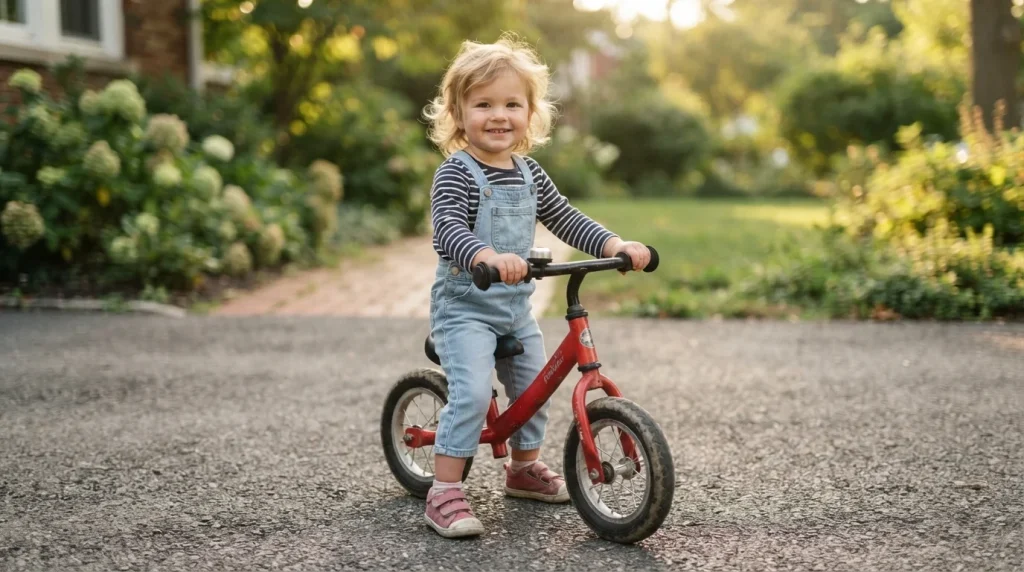
The right bike allows your toddler to reach the pedals, control the handlebars, and maintain a comfortable riding position without stretching.
Check the Seat Height
A suitable seat height allows your toddler to reach the pedals throughout their circular movement without excessively stretching their legs.
For a beginner learning to balance on a pedal bike, being able to place both feet securely on the ground can improve confidence.
Adjust the seat according to the bicycle manufacturer’s instructions. Never raise the seatpost beyond its marked insertion limit.
Consider the Bike Weight
A manageable bicycle weight makes starting, steering, and controlling the bike easier for a young rider.
If your toddler struggles to move the bicycle despite understanding the pedaling action, check whether the bike is difficult for them to handle.
Check Pedal and Handlebar Position
Proper pedal and handlebar positions allow your toddler to ride without excessive reaching or an uncomfortable body position.
Your child’s feet should rest securely on the pedals. Their hands should reach the handlebars without leaning excessively forward.
Tricycle, Balance Bike, or Pedal Bike for Toddlers?
Tricycles help children practice pedaling, balance bikes develop balance, and conventional pedal bikes combine pedaling with steering and independent balance.
The following table compares these options according to their learning purpose.
| Bike Type | Primary Skill | Suitable Situation |
|---|---|---|
| Tricycle | Pedaling coordination | Learning circular pedal movements |
| Balance bike | Balance and steering | Building riding confidence before pedaling |
| Bike with training wheels | Pedaling with additional stability | Children learning pedal coordination |
| Pedal bike without training wheels | Independent cycling | Children ready to combine balance and pedaling |
Choose the bicycle type according to the skill your toddler needs to develop rather than expecting every child to follow the same learning path.
How to Teach a Toddler to Pedal a Bike Step by Step
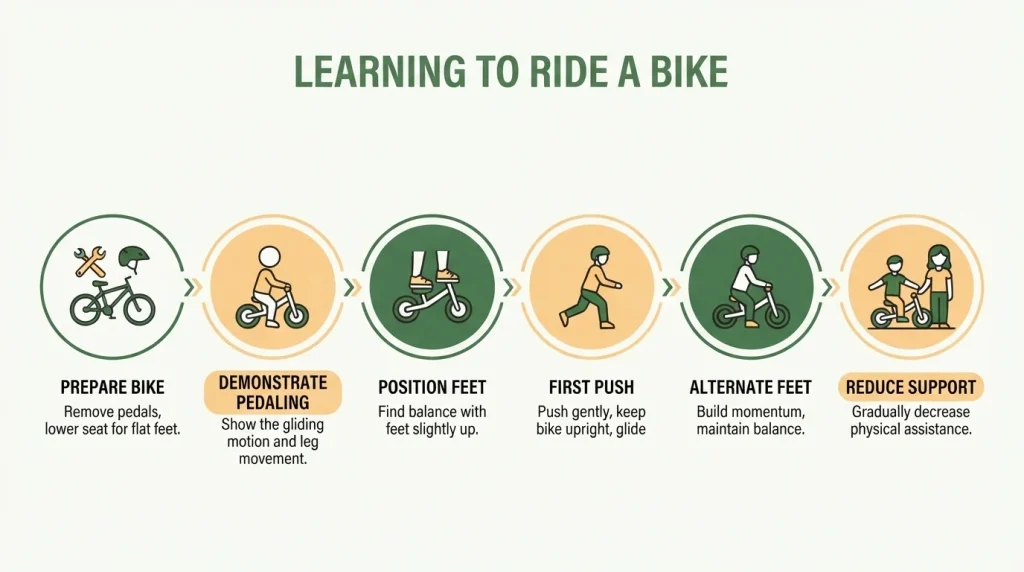
Teach your toddler to pedal by demonstrating the movement, practicing controlled starts, and gradually allowing them to move the bicycle independently.
Step 1
Prepare the bicycle
Adjust the seat, check the pedals, and make sure the bicycle operates correctly. Choose a flat practice area away from traffic.
Step 2
Demonstrate pedaling
Show your toddler how the pedals move forward in a circle. Explain the movement using simple words.
Step 3
Position their feet
Help your toddler place their feet comfortably on the pedals while keeping their hands on the handlebars.
Step 4
Practice the first push
Position one pedal forward and above the lowest point. Encourage your child to push it down while you provide gentle support.
Step 5
Continue alternating feet
Encourage your toddler to continue pushing each pedal as it comes forward. Allow them to discover a comfortable rhythm.
Step 6
Reduce assistance gradually
Give your toddler more control as their coordination improves. Remain close enough to assist when necessary.
Teach Forward Pedaling First
Forward pedaling helps your toddler understand how foot pressure moves the bicycle.
Use simple instructions such as push down and keep going. Avoid giving several instructions at once.
If your child stops after pushing one pedal, show how the opposite pedal moves into position for the next push.
Practice Starting From a Stopped Position
Starting with a raised, forward-facing pedal gives your toddler a useful position for applying pressure and moving the bicycle.
Practice starting and stopping repeatedly in a controlled area. Once your child becomes comfortable starting, encourage them to continue pedaling for longer distances.
Tip
Place a visible chalk mark on the pavement as a stopping target. Give your toddler a simple destination instead of asking them to pedal indefinitely.
Exercises That Help Toddlers Learn Pedaling
Simple movement exercises can help toddlers become familiar with the alternating leg movements required for pedaling a bicycle.
Practice Air Cycling
Air cycling allows toddlers to explore circular leg movements without controlling a bicycle.
Encourage your child to lie comfortably on their back and pretend to ride a bicycle. Let them move their legs naturally without forcing their joints.
Practice With a Tricycle
A tricycle allows toddlers to concentrate on pedaling without needing to balance independently on two wheels.
Choose a tricycle with accessible pedals and a comfortable seat. Encourage your child to move forward using their own effort whenever possible.
Encourage Active Play
Active play provides opportunities for toddlers to develop movement control and confidence.
Walking, dancing, and age-appropriate playground activities allow children to explore different leg movements. These activities can complement bicycle practice without replacing actual pedaling experience.
Common Toddler Pedaling Problems and Solutions
Most early pedaling difficulties can be addressed by adjusting the bicycle, simplifying instructions, or practicing individual riding skills.
Why Does My Toddler Pedal Backward?
Toddlers may pedal backward because they have not yet associated forward pedal movement with moving the bicycle.
Demonstrate forward rotation and help your child position a pedal for the next downward push. Remember that bicycles with coaster brakes may stop when the pedals move backward.
Why Does My Toddler Keep Taking Their Feet Off the Pedals?
Toddlers may remove their feet from the pedals because of poor bicycle fit, uncertainty, fatigue, or difficulty coordinating their movements.
Check whether your child can comfortably reach both pedals throughout each rotation. Make sure their shoes fit securely.
Allow your child to reposition their feet independently instead of repeatedly moving their legs for them.
Why Can My Toddler Pedal but Not Move Forward?
A toddler who pedals without moving forward may be struggling with pedal direction, starting resistance, or a mechanical bicycle problem.
Check the following before continuing:
- Whether the pedals are rotating forward.
- Whether the bicycle wheels turn freely.
- Whether the brakes are dragging.
- Whether the tires are properly inflated.
- Whether the bicycle fits your child.
If the bicycle does not operate correctly, have the mechanical problem repaired before further practice.
Why Does My Toddler Stop After Each Pedal Push?
Stopping after each push may indicate that your toddler has not yet learned how to connect alternating pedal movements.
Use consistent verbal cues to encourage continuous movement. Practice on a smooth surface where your child does not need excessive effort to keep moving.
How to Help a Toddler Pedal Without Training Wheels
Helping a toddler pedal without training wheels requires independent balance, steering, braking, and sufficient physical readiness.
Do not rush a toddler into unsupported two-wheel cycling. Continue using age-appropriate riding equipment until your child demonstrates the necessary skills.
For a child who is ready to transition, practice these skills in order:
- Push along the ground using both feet.
- Glide briefly while maintaining balance.
- Practice controlled steering and stopping.
- Learn to start using a raised pedal.
- Combine forward pedaling with balance.
The Cycling UK bicycle learning guide explains how balance practice can prepare children for independent pedaling.
Support your child gently around their upper body when needed. Avoid controlling the handlebars continuously because your child needs opportunities to learn steering.
How to Motivate a Toddler to Keep Pedaling
Toddlers are more likely to continue practicing when cycling feels enjoyable rather than demanding.
Celebrate small achievements, such as placing both feet on the pedals or completing a forward rotation. Avoid comparing your child’s progress with other children.
Simple ways to encourage practice include:
- Turn pedaling into a supervised game.
- Let your toddler choose a nearby destination.
- Demonstrate riding on your own bicycle.
- Praise effort instead of speed or distance.
- Allow your toddler to take breaks.
- Finish practice before frustration develops.
Some children prefer watching others ride before attempting the movement themselves. Give your toddler opportunities to observe without demanding immediate participation.
How Long Does It Take a Toddler to Learn Pedaling?
The time required for a toddler to learn pedaling depends on physical readiness, coordination, bicycle fit, motivation, and previous riding experience.
There is no universal learning schedule that applies to every toddler. Some children need repeated practice before they understand continuous pedal rotation.
Focus on gradual improvements rather than setting a deadline. A successful practice session may involve better foot placement, smoother starts, or greater confidence.
Mistakes to Avoid When Teaching Toddlers to Pedal
Avoid teaching methods that create unnecessary pressure, interfere with independent movement, or make cycling unsafe.
Do
- Choose a properly fitted bike.
- Give short and clear instructions.
- Let your toddler practice at their own pace.
- Celebrate small improvements.
- Provide appropriate adult supervision.
Avoid
- Buying an oversized bicycle.
- Forcing your toddler’s legs to move.
- Practicing near moving vehicles.
- Continuing when your child becomes tired.
- Removing riding support before your child is ready.
Let your child develop confidence through manageable challenges. Increasing the difficulty too quickly may make riding less enjoyable.
Safety Tips for Teaching a Toddler to Pedal
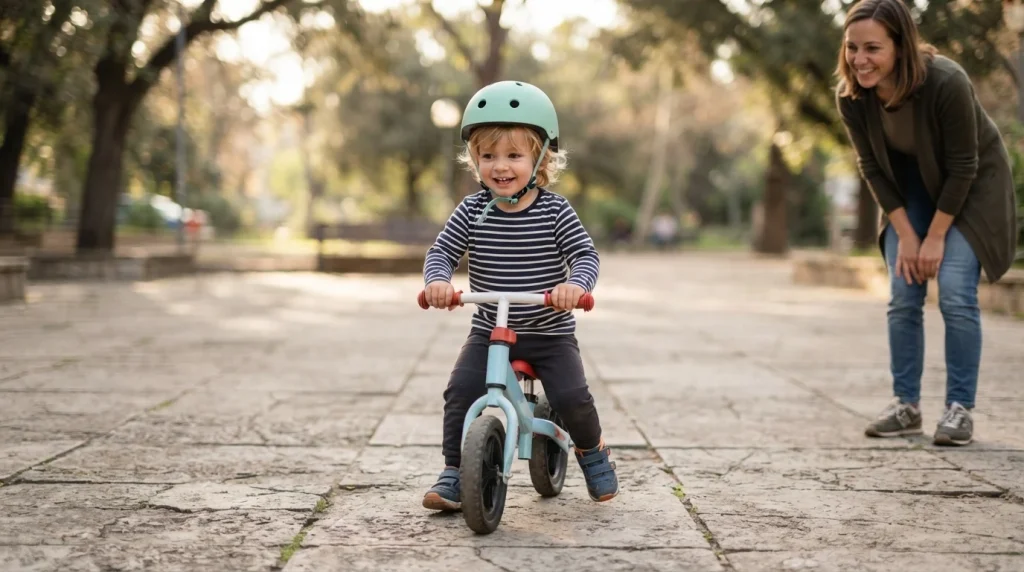
Safe toddler cycling requires properly fitted protective equipment, suitable riding conditions, and close adult supervision.
The American Academy of Pediatrics provides guidance on choosing the right bicycle and helmet for children.
- Use a correctly fitted bicycle helmet that meets applicable safety standards.
- Choose a flat riding area separated from vehicle traffic.
- Check the bicycle’s brakes, wheels, pedals, and steering.
- Choose secure footwear and avoid loose clothing.
- Supervise your toddler throughout every practice session.
- Stop riding if your child loses control or becomes exhausted.
Warning
Never teach a toddler to pedal near traffic. Young children need direct adult supervision in a protected riding area.
When Should You Seek Additional Help?
Additional professional guidance may be helpful when your toddler has persistent movement difficulties that affect cycling and other everyday physical activities.
Difficulty learning to pedal alone does not establish a developmental problem. Children acquire physical skills at different rates.
Discuss persistent pain, unusual weakness, or broader movement concerns with your child’s pediatrician. A pediatric physical therapist may provide individualized movement guidance when appropriate.
Essential Equipment for Toddler Pedaling Practice
Toddler pedaling practice requires age-appropriate riding equipment rather than specialized training accessories.
A correctly fitted bicycle or tricycle and a suitable helmet provide the basic equipment for supervised practice. Choose equipment according to your child’s size and developmental readiness.
If you purchase through an affiliate link, the website may earn a commission.
Toddler Pedal Tricycle
A properly fitted toddler tricycle provides a stable platform for practicing pedaling and steering under adult supervision.
Frequently Asked Questions
Can a toddler learn to pedal indoors?
Toddlers can practice pedaling indoors when they have a suitable riding toy and a spacious area without obstacles. Choose a level surface away from stairs, furniture corners, and fragile objects. Maintain direct adult supervision and follow the equipment manufacturer’s instructions.
Should toddlers wear shoes while learning to pedal?
Toddlers should wear securely fitted shoes that provide comfortable contact with the pedals and protect their feet during riding practice. Avoid loose sandals or footwear that easily slips off. Check that shoelaces cannot become caught in moving bicycle components.
Can a balance bike teach a toddler to pedal?
A balance bike cannot directly teach pedaling because it does not have pedals, but it can develop related riding skills. Children can practice steering, gliding, and controlling their movement. They still need separate practice to learn the alternating leg movements of pedaling.
Should I push my toddler’s tricycle while practicing?
Gentle assistance can help a toddler begin moving, provided the tricycle is suitable for assisted riding and the child remains comfortable. Follow the manufacturer’s instructions when using a parent push handle. Allow your toddler to contribute their own effort as their coordination improves.
Can a toddler practice pedaling on grass?
Toddlers can practice on firm, level grass, but softer or uneven ground may require more effort than smooth pavement. Beginners may find continuous pedaling difficult when the wheels meet additional resistance. Choose a protected, smooth surface if your child struggles to move forward.
Should toddlers use pedal straps when learning to cycle?
Toddlers learning ordinary recreational cycling should generally use pedals that allow them to reposition and remove their feet easily. Avoid improvised straps that could trap their feet during a fall. Specialized adaptive cycling equipment should be selected with appropriate professional guidance.
Conclusion
Learning how to help a toddler pedal a bike requires patience, suitable equipment, and gradual practice. Begin with simple forward pedal movements and provide gentle support as your child develops coordination. If balancing remains difficult, continue practicing with age-appropriate riding equipment before attempting independent cycling.
