How to Teach a Kid to Ride a Bike in 5 Minutes: 5 Steps
Quick Answer
To teach a kid to ride a bike in 5 minutes, start with a properly fitted bicycle and practice balancing before pedaling. Encourage your child to push off, glide, look forward, and pedal when ready. Five minutes may be enough for a confident child, but beginners often need additional practice.
- Choose a flat, traffic-free practice area.
- Adjust the bicycle seat for comfortable ground contact.
- Practice pushing, gliding, and balancing.
- Introduce pedaling when your child can glide confidently.
- Practice independent starting and controlled stopping.
Teaching your child to ride a bicycle does not have to involve hours of frustrating practice. A short, balance-first lesson can make learning easier, especially for children who already feel comfortable on two wheels.
This guide explains how to organize a five-minute bicycle lesson, avoid common teaching mistakes, and help your child develop independent riding skills safely.
Can You Teach a Kid to Ride a Bike in 5 Minutes?
A child who already understands bicycle balance may begin riding independently within five minutes. However, children who have never balanced on two wheels usually need more practice.
The Chester Cycling Campaign explains that some children learn within five minutes using the pedals-off teaching method. This outcome depends on the child’s existing skills and readiness.
The purpose of a short lesson is to introduce the correct movements rather than meet a strict deadline.
Your child may learn quickly if they can already:
- Balance comfortably on a balance bike.
- Steer without losing control.
- Push themselves forward independently.
- Understand basic braking instructions.
- Remain relaxed while the bicycle moves.
If these skills are missing, spend more time developing balance before introducing independent pedaling.
How to Prepare Your Child for a Bike Riding Lesson

Preparing the bicycle, safety equipment, and practice area before the lesson allows your child to focus on learning.
Choose the Correct Bicycle Size
A properly fitted kids’ bike allows your child to reach the handlebars comfortably and maintain control when stopping.
Avoid using an oversized bicycle simply because your child will eventually grow into it. A bicycle that is too large can make mounting, steering, and stopping more difficult.
During balance practice, adjust the saddle so your child can place both feet flat on the ground with slightly bent knees.
Check the Bicycle Helmet
A correctly fitted bicycle helmet helps protect your child’s head during falls and should be worn throughout every riding lesson.
The American Academy of Pediatrics recommends using a helmet that meets Consumer Product Safety Commission bicycle helmet standards.
Follow these bicycle and helmet fitting guidelines before beginning the lesson.
Find a Safe Practice Area
A flat, smooth, traffic-free surface gives beginner cyclists enough room to practice balancing and stopping.
Suitable practice locations include:
- Empty school playgrounds where cycling is permitted.
- Traffic-free paved recreation areas.
- Wide, level private paths.
- Empty sports courts where bicycles are allowed.
Avoid steep slopes, loose gravel, busy sidewalks, and areas where vehicles may enter unexpectedly.
Inspect the Bicycle
A basic bicycle inspection helps identify mechanical problems that could interfere with your child’s first riding lesson.
- Check that the tires are properly inflated.
- Confirm that the brakes work correctly.
- Make sure the handlebars are secure.
- Check that the saddle cannot twist or move.
- Ensure the wheels rotate freely.
- Secure loose clothing and shoelaces.
Complete these checks before starting the five-minute practice session.
How to Teach a Kid to Ride a Bike in 5 Minutes
A five-minute bicycle lesson works by dividing independent riding into balance, movement, pedaling, and stopping exercises.
The following schedule is a suggested teaching routine, not a guaranteed learning time. Move to the next exercise only when your child is comfortable.
Step 1
Minute 1: Practice Sitting and Braking
Let your child sit comfortably on the bicycle with both feet supported. Explain how to steer and stop.
Step 2
Minute 2: Push and Glide
Use a balance bike or prepared pedal-free bicycle. Encourage your child to push forward and briefly lift their feet when stable.
Step 3
Minute 3: Build Balance
Encourage longer controlled glides while looking forward. Practice gentle steering and stopping before progressing.
Step 4
Minute 4: Introduce Pedaling
If your child has mastered balance and braking, introduce a properly prepared pedal bike. Practice pushing off and finding the pedals.
Step 5
Minute 5: Practice Independent Riding
Stay close while your child practices riding, starting, and stopping independently. End the lesson with positive encouragement.
Children who need more balance practice should remain on the earlier exercises. Bicycle preparation and pedal installation should not be rushed to meet the suggested schedule.
Why the Balance-First Method Helps Children Learn Faster
The balance-first method separates bicycle balance from pedaling, allowing children to develop riding skills gradually.
A beginner must coordinate steering, balance, pedal movement, and braking. Introducing these tasks together can make the learning process more challenging.
A balance bike removes the need to pedal. Children can concentrate on controlling the bicycle while using their feet for support and movement.
Ireland’s Health Service Executive explains the balance bike learning method as a way to break bicycle riding into manageable stages.
Once your child can glide and steer comfortably, introduce pedaling as the next skill.
Should You Remove the Pedals and Training Wheels?
Removing the pedals and training wheels from a suitable bicycle can help children practice independent two-wheel balance.
Training wheels support the bicycle during pedaling practice. However, they reduce the need for the rider to develop independent balance.
A dedicated balance bike offers an alternative if your child is not comfortable using a modified pedal bicycle.
The following table compares common bicycle learning methods.
| Learning Method | Primary Skill | Suitable For |
|---|---|---|
| Balance bike | Balance and steering | Children learning two-wheel control |
| Pedals-off method | Independent balance | Children with suitable pedal bikes |
| Training wheels | Pedaling familiarity | Children practicing supported pedaling |
| Regular pedal bike | Combined riding skills | Children who can already balance |
A balance bike or properly prepared pedal-free bicycle is a useful choice when independent balance is the main learning goal.
Warning
Removing pedals may make a coaster brake unusable. Use a suitable balance bike or confirm effective independent braking before practicing.
How to Teach a Child to Start Pedaling Independently

Independent pedaling begins with a stable starting position and a controlled push that moves the bicycle forward.
Ask your child to sit comfortably with one foot on the ground. Position the other foot on a raised forward pedal.
Encourage your child to press down on the pedal and push gently from the ground. Once moving steadily, they can place their other foot on the remaining pedal.
Avoid expecting your child to balance while the bicycle is completely stationary. Allow controlled forward movement in a clear practice area.
Practice starting separately from turning or riding longer distances.
How to Teach Your Child to Stop Safely
Children should learn controlled braking before attempting independent bicycle rides.
Show your child how the bicycle’s braking system works. Explain the difference between squeezing hand brakes and operating a coaster brake, depending on their bicycle.
Begin with walking-speed movements and ask your child to stop at a designated location.
- Choose a visible stopping point.
- Ask your child to approach slowly.
- Encourage gradual brake application.
- Let the bicycle come to a controlled stop.
- Place a foot securely on the ground.
Repeat the exercise until your child can stop without relying on an adult to catch the bicycle.
How to Help a Child Who Is Afraid of Falling
Helping a child overcome bicycle fear requires manageable exercises, a comfortable bicycle, and patient encouragement.
Some children feel nervous when their feet leave the ground. Others worry because they have previously fallen or experienced an uncomfortable riding lesson.
Start with movements that allow your child to maintain control.
- Let your child walk the bicycle first.
- Practice mounting and dismounting.
- Encourage short pushes with their feet.
- Celebrate small improvements.
- Allow breaks whenever needed.
Avoid comparing your child’s progress with another child’s riding ability. Confidence develops through successful experiences rather than pressure.
How to Know When Your Child Is Ready for Pedals
A child is ready to practice pedaling when they can balance, steer, and stop the bicycle without constant physical support.
Watch your child’s movements instead of relying only on their age or the amount of time spent practicing.
Signs of readiness include:
- Gliding with both feet lifted.
- Looking ahead while moving.
- Making controlled steering adjustments.
- Stopping at an intended location.
- Recovering from small balance changes.
- Showing interest in trying pedals.
REI’s child bicycle riding guide recommends introducing pedals after children develop controlled gliding and steering skills.
Common Mistakes When Teaching Kids to Ride Bikes
Common bicycle teaching mistakes include rushing the lesson, using an unsuitable bicycle, and providing too much physical assistance.
Do
- Use short, manageable practice sessions.
- Encourage relaxed forward vision.
- Let your child develop independent balance.
- Practice braking and steering.
- Respect your child’s learning pace.
Avoid
- Forcing your child to ride.
- Practicing near moving vehicles.
- Constantly controlling the handlebars.
- Skipping braking exercises.
- Using an oversized bicycle.
Remain close enough to assist when necessary, but allow your child to experience balancing independently when it is safe.
What If Your Child Cannot Ride After Five Minutes?
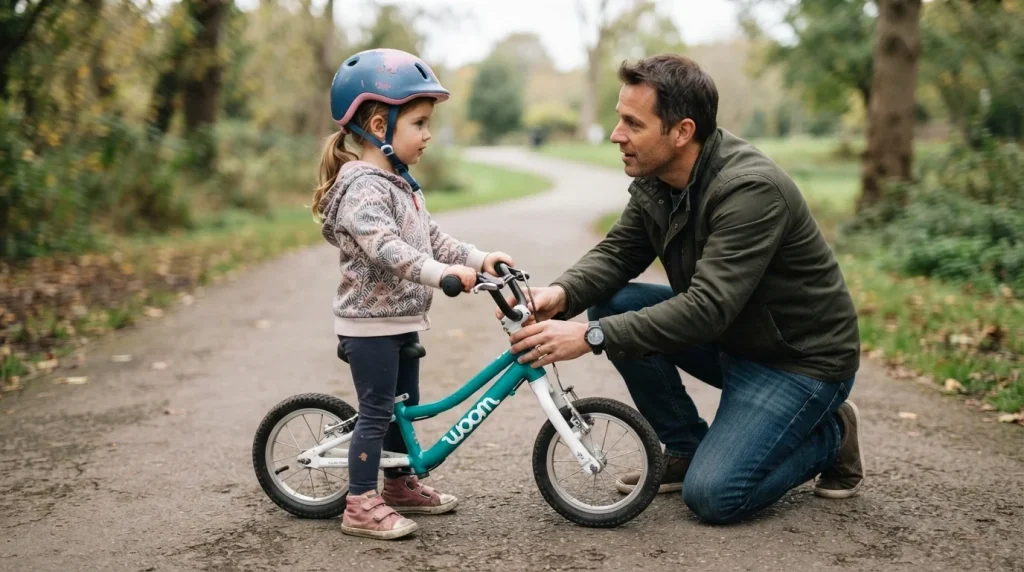
A child who cannot ride independently after five minutes may need additional practice with balance, coordination, or confidence.
Identify the specific skill causing difficulty before repeating the entire lesson.
| Problem | Possible Cause | Practice Adjustment |
|---|---|---|
| Frequent wobbling | Developing balance | Return to gliding exercises |
| Difficulty starting | Poor starting position | Practice pedal positioning |
| Looking downward | Uncertainty about foot placement | Practice looking toward a target |
| Fear of movement | Limited confidence | Begin with short scooting exercises |
| Difficulty stopping | Unfamiliar or unsuitable brakes | Check brake fit and practice stopping |
Focus on the individual skill your child finds difficult rather than increasing the pressure to ride independently.
If your child has persistent coordination difficulties, consider working with an adaptive cycling instructor or pediatric occupational therapist.
What Should You Do After Your Child Learns to Ride?
After your child’s first independent ride, continue practicing bicycle control before introducing more challenging riding environments.
Riding in a straight line is only one part of learning to cycle. Children must also develop the ability to react, steer, and stop safely.
Introduce the following skills gradually:
- Starting without adult assistance.
- Making wide, controlled turns.
- Stopping at specific locations.
- Maintaining a comfortable riding speed.
- Recognizing and avoiding obstacles.
- Following basic bicycle safety instructions.
Keep practice supervised and away from traffic until your child develops the skills and judgment needed for more demanding environments.
Kids Balance Bikes
A properly fitted balance bike allows children to practice steering and balance before learning to pedal.
Frequently Asked Questions
Can a four-year-old learn to ride a bike?
A four-year-old can learn to ride a bicycle if they have sufficient coordination, physical control, confidence, and interest in learning. Readiness varies between children of the same age. Choose a bicycle that fits their body and introduce balance exercises before expecting independent pedaling.
Can a child learn without a balance bike?
A child can learn without a dedicated balance bike by practicing on a suitable pedal bicycle that has been safely converted for balance exercises. Removing the pedals provides room for ground pushes. Confirm that the modified bicycle has effective braking and remains mechanically safe before using it.
Is grass better for learning to ride?
A smooth, level paved surface is generally easier for beginner cyclists because grass creates additional resistance and can make movement harder. Uneven grass may also hide bumps or holes. Choose a clear, traffic-free paved area with enough room for controlled turns and stopping.
Can an older child use the balance-first method?
Older children can use the balance-first method because learning independent bicycle control does not require starting at a particular age. Choose a bicycle that fits the child’s height and reach. Allow private, low-pressure practice if the child feels embarrassed about learning later than their friends.
Should kids wear knee pads when learning?
Knee pads and elbow pads can provide additional protection during minor falls, especially for children who feel nervous about learning to ride. Protective pads should fit comfortably without restricting movement. They do not replace a properly fitted bicycle helmet, effective brakes, or appropriate adult supervision.
Should I use a bicycle training handle?
A compatible bicycle training handle may help an adult provide temporary assistance while a child practices starting and controlling the bicycle. However, constant physical support can limit opportunities to develop independent balance. Use assistance only when needed and reduce it gradually as your child becomes more comfortable.
Conclusion
The safest approach to how to teach a kid to ride a bike in 5 minutes is to develop balance before introducing pedals. Treat five minutes as a practice goal rather than a deadline. If your child struggles, return to controlled gliding and continue at their own pace.
