How to Teach a 4-Year-Old to Ride a Bike: Simple Steps
Quick Answer
To teach a 4-year-old to ride a bike, start with a properly fitted bicycle and teach balance before pedaling. Practice in a flat, traffic-free area while your child wears a fitted helmet. Introduce steering, braking, and pedaling gradually. Keep practice sessions enjoyable and allow your child to progress at their own pace.
- Choose a bicycle that fits your child comfortably.
- Teach walking, balancing, and gliding.
- Practice steering and controlled stopping.
- Introduce pedaling when your child feels confident.
- Gradually reduce physical support.
Learning how to ride a bicycle can be an exciting milestone for a preschooler. Knowing how to teach a 4-year-old to ride a bike helps you make the experience safer, easier, and more enjoyable.
This guide explains how to prepare your child’s bicycle, teach essential riding skills, overcome common difficulties, and encourage independent riding without unnecessary pressure.
Is a 4-Year-Old Ready to Learn to Ride a Bike?
A 4-year-old may be ready to learn bicycle riding if they have sufficient balance, coordination, physical strength, and interest. Readiness depends more on individual development than age alone.
The American Academy of Pediatrics recommends waiting until children are developmentally ready for independent two-wheel riding, which may happen at an older age.
Your child may be ready to begin learning if they can:
- Walk and run with reasonable balance.
- Follow simple instructions.
- Sit comfortably on a bicycle.
- Push a balance bike forward using their feet.
- Control the handlebars while moving.
- Show interest in learning to ride.
- Respond when asked to stop.
Your child does not need to demonstrate every skill before starting basic balance practice. However, independent pedal riding should wait until they have developed adequate control.
How to Choose the Right Bike for a 4-Year-Old

The right bicycle for a 4-year-old allows comfortable ground contact, easy steering, controlled braking, and confident movement. Choose the bicycle according to your child’s measurements rather than age alone.
Check the Seat Height
A suitable learning seat height allows your child to reach the ground comfortably while sitting on the saddle. For balance practice, lower the seat so both feet can rest flat on the ground.
Ground contact helps beginners regain stability when they feel the bicycle leaning. The saddle can be adjusted for more efficient pedaling once your child develops confidence.
Check the Handlebar Reach
Handlebars should be within comfortable reach without forcing your child to stretch their arms or lean excessively forward.
Your child should be able to turn the handlebars while maintaining a relaxed sitting position. Uncomfortable reach can interfere with steering and balance.
Consider Bicycle Weight
A manageable bicycle weight helps young children start moving, change direction, and recover their balance. A bicycle that feels difficult to move may discourage a beginner.
Allow your child to walk beside the bicycle before beginning a lesson. Notice whether they can guide it without struggling.
Check the Brakes
Children need brakes that they can operate comfortably and reliably. Check that your child understands how the bicycle stops before allowing independent riding.
Follow the American Academy of Pediatrics bicycle fitting guidance when selecting and adjusting a child’s bicycle.
Should You Use a Balance Bike or Training Wheels?
A balance bike helps children develop independent balance before learning to pedal. Training wheels provide additional stability while children become familiar with pedaling and sitting on a bicycle.
The following table compares the learning methods available to parents.
| Learning Feature | Balance Bike | Training Wheels |
|---|---|---|
| Balance | Develops independent balance | Provides external support |
| Movement | Foot-powered movement | Pedal-powered movement |
| Steering | Practices natural balancing and turning | Practices supported steering |
| Learning Focus | Balance before pedaling | Pedaling before independent balance |
| Transition | Introduces pedals after balance develops | Requires learning balance after support removal |
For a child working toward independent two-wheel riding, the balance-first method separates balancing from pedaling and simplifies the learning process.
If you already own a suitable pedal bicycle, a bicycle mechanic can remove its pedals for temporary balance practice.
Prepare a Safe Environment for Bike Lessons
A flat, open, traffic-free area gives your child space to practice without unnecessary obstacles or distractions.
Suitable practice locations include:
- Empty paved playgrounds where cycling is permitted.
- Traffic-free recreation areas.
- Quiet, wide cycling practice spaces.
- Empty sports courts where bicycles are allowed.
Avoid steep slopes, moving vehicles, loose gravel, wet surfaces, and crowded pathways. Grass may feel less intimidating, but uneven ground and rolling resistance can make balancing harder.
Check the tires, brakes, saddle, handlebars, and wheel security before each lesson. Your child should wear closed-toe shoes and clothing that cannot become caught in moving bicycle parts.
Warning
Never teach a preschooler to ride near moving vehicles. Young children need direct adult supervision and a practice area separated from road traffic.
The American Academy of Pediatrics provides additional bicycle safety guidance for parents introducing children to cycling.
How to Teach a 4-Year-Old to Ride a Bike Step by Step
Teach bicycle riding by introducing individual skills before combining them. Begin with basic bicycle control, progress to independent balance, and introduce pedals only when your child is ready.
Step 1
Introduce the Bicycle
Let your child explore the bicycle, hold the handlebars, and practice getting on and off while you provide support as needed.
Step 2
Practice Walking While Seated
Use a balance bike or suitably converted pedal bike. Encourage your child to move forward using their feet while sitting on the saddle.
Step 3
Develop Gliding Skills
Encourage longer pushes followed by briefly lifting both feet. Allow your child to discover how the moving bicycle stays balanced.
Step 4
Practice Steering and Stopping
Introduce gentle turns and controlled stops. Make sure your child understands how to slow down using the available brakes.
Step 5
Introduce the Pedals
Move to a pedal bicycle when your child can glide, turn, and stop confidently. Practice finding the pedals while the bicycle is stationary and supported.
Step 6
Teach Independent Starting
Position a pedal forward and upward. Encourage your child to push down while placing the other foot onto the opposite pedal.
Step 7
Reduce Physical Support
Stay beside your child as they practice riding. Gradually reduce assistance while remaining close enough to supervise and respond when necessary.
Repeat individual steps whenever your child struggles. Progress to the next skill only when the preceding movement feels comfortable and controlled.
The Cycling UK riding guide offers additional instruction on developing independent bicycle riding skills.
How to Teach a 4-Year-Old to Pedal a Bike

Teach pedaling after your child develops basic balance and steering skills. Separating these movements allows your child to concentrate on turning the pedals without learning every riding skill simultaneously.
Begin with the bicycle stationary and supported. Show your child where to place their feet and demonstrate how pressing a raised pedal moves the bicycle forward.
When your child understands the movement, practice starting with one foot on the raised pedal and the other on the ground.
Encourage your child to press down, move forward, and bring the other foot onto its pedal. Remind them to look ahead instead of watching their feet.
If pedaling causes repeated loss of balance, return to gliding practice before attempting another pedal start.
How to Teach a Child to Brake and Stop Safely
Teach braking before allowing your child to ride independently. A child who can pedal but cannot stop reliably has not yet mastered safe bicycle control.
Using Hand Brakes
Hand brakes require your child to squeeze brake levers while maintaining control of the handlebars. Check that the levers fit their hands and can be operated effectively.
Begin by having your child walk beside the bicycle while practicing gentle brake pressure. Progress to slow riding and controlled stopping once they understand the movement.
Using Coaster Brakes
A coaster brake slows the bicycle when the rider presses backward on the pedals. Teach this action while supporting the stationary bicycle before practicing at low speed.
Use whichever braking system the bicycle is designed to operate. Do not modify or disable its brakes to simplify learning.
How Long Does It Take a 4-Year-Old to Learn?
The time required to learn bicycle riding varies according to balance, coordination, confidence, bicycle fit, and previous experience.
Children with balance bike experience may find the transition to pedaling easier. Children who are unfamiliar with bicycles may need more practice before they can ride independently.
Instead of setting a deadline, observe improvements in individual skills:
- Getting on and off the bicycle comfortably.
- Gliding without immediate foot contact.
- Steering through gentle turns.
- Stopping when instructed.
- Starting without physical assistance.
End lessons before your child becomes exhausted or loses interest. Positive experiences can encourage them to return for additional practice.
What If Your 4-Year-Old Is Afraid to Ride a Bike?
A child who fears riding may need smaller learning steps, a more suitable bicycle, or additional time to become comfortable.
Identify the source of their concern before continuing. Some children worry about falling, while others dislike the feeling of movement or being unable to reach the ground.
Try these approaches:
- Allow your child to explore the stationary bicycle.
- Return to walking and gliding practice.
- Use a familiar, quiet practice location.
- Demonstrate movements before asking your child to copy them.
- Celebrate small improvements without comparing children.
- Allow breaks whenever your child becomes uncomfortable.
Avoid releasing your physical support without telling your child. Knowing what to expect can help them feel more secure during practice.
Common Mistakes When Teaching a Child to Ride
Common teaching mistakes include using an oversized bicycle, rushing the learning process, and introducing complicated movements before your child develops basic control.
Do
- Choose a bicycle that fits.
- Teach balance before pedals.
- Use simple instructions.
- Practice controlled stopping.
- Encourage gradual progress.
Avoid
- Buying an oversized bicycle.
- Forcing an unwilling child to ride.
- Practicing on steep slopes.
- Ignoring braking skills.
- Setting unrealistic deadlines.
Successful lessons focus on developing control rather than achieving immediate independent riding. Adapt your teaching approach to your child’s individual abilities.
Fun Activities to Improve Bicycle Riding Skills
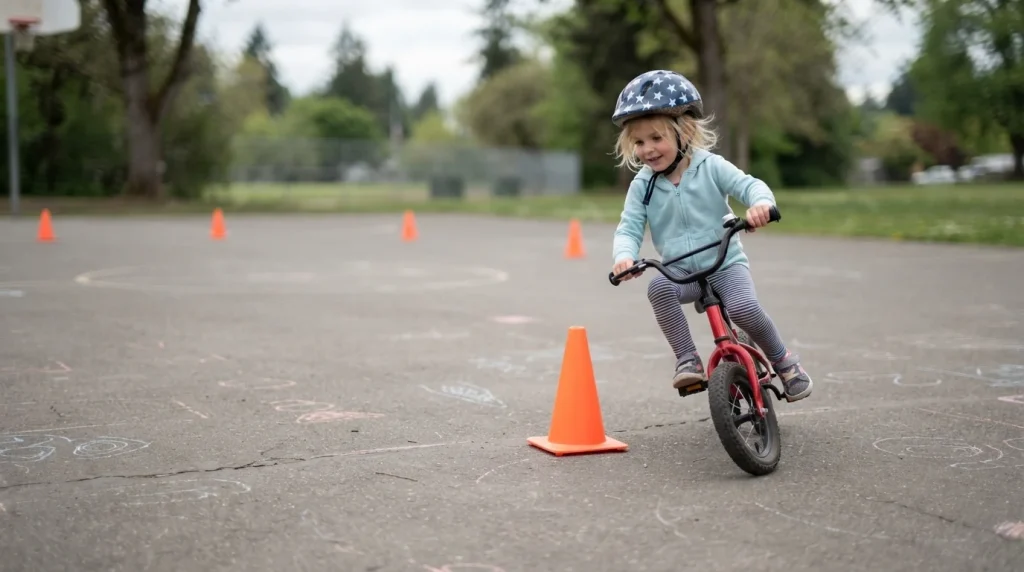
Simple riding games can help children practice balance, steering, and stopping while maintaining their interest in cycling.
Follow the Line
Following a straight line encourages your child to look ahead and maintain a steady riding direction. Use a chalk line in an open practice area.
Begin with walking or gliding along the line before introducing pedal-powered riding.
Red Light, Green Light
Red light, green light helps children practice responding to instructions and stopping under control.
Ask your child to move when you say green light and stop when you say red light. Begin at walking speed and leave enough space for comfortable stopping.
Wide Turns Around Cones
Riding around soft markers helps children practice steering and changing direction. Place the markers far apart so your child can make gentle turns.
Avoid timed races or tight turns while your child is still developing basic balance.
When Can a 4-Year-Old Ride Without Assistance?
A 4-year-old may be ready for unsupported riding when they can start, pedal, steer, and stop without physical assistance. However, unsupported riding does not mean unsupervised riding.
Before reducing your assistance, check whether your child can:
- Mount and dismount safely.
- Start moving independently.
- Maintain balance while pedaling.
- Look ahead while riding.
- Turn without losing control.
- Stop reliably using the brakes.
- Follow your safety instructions.
Continue supervising every ride in a suitable traffic-free area. Introduce unfamiliar environments only when your child’s development and riding skills support the change.
Essential Safety Equipment for Learning to Ride
A properly fitted children’s bicycle helmet is essential for every riding lesson. Choose a helmet that meets applicable US Consumer Product Safety Commission bicycle helmet standards.
The helmet should sit level, cover the upper forehead, and remain secure when your child moves their head. Adjust the chin strap according to the manufacturer’s instructions.
Additional protective equipment, such as correctly fitted knee and elbow pads, may help protect against minor scrapes. Protective equipment does not replace supervision or safe riding conditions.
Check that all equipment fits comfortably and does not interfere with steering, pedaling, or braking.
As an Amazon Associate, this site earns from qualifying purchases.
Children’s Bicycle Helmet
A correctly fitted bicycle helmet helps protect your child’s head during bicycle riding practice.
Frequently Asked Questions
These additional questions address common situations parents may encounter while introducing preschool children to bicycle riding.
Can a 4-year-old learn without a balance bike?
A 4-year-old can practice independent balance using a properly fitted pedal bicycle that has been safely converted for foot-powered movement. A bicycle mechanic can remove the pedals and reinstall them when your child is ready. Make sure the braking system remains functional throughout the learning process.
Should parents hold the handlebars while teaching?
Parents should avoid controlling the handlebars during moving practice because children need opportunities to develop their own steering and balance skills. Provide gentle physical support when necessary without interfering with steering. You can help stabilize the bicycle during stationary exercises and gradually reduce assistance during movement.
Should a child practice bike riding every day?
A child can practice bicycle riding regularly whenever they feel interested, comfortable, and physically ready to participate in supervised lessons. Daily practice is not a requirement for learning. Allow recovery time when your child feels tired or frustrated, and prioritize enjoyable experiences over maintaining a strict schedule.
Can siblings help teach a preschooler to ride?
Older siblings can demonstrate bicycle riding movements and encourage a preschooler, provided a responsible adult directly supervises the learning session. Watching another child ride may increase interest in cycling. Adults should remain responsible for equipment checks, safety boundaries, physical assistance, and decisions about when independent practice is appropriate.
Is professional bicycle training helpful for young children?
Professional bicycle training may help children who benefit from structured instruction, additional encouragement, or a different approach to learning riding skills. Choose an instructor who has experience teaching young children. Confirm that the program accepts preschoolers and provides suitable equipment, supervision, and traffic-free practice conditions.
What if my child forgets how to pedal?
A beginner who struggles to pedal after a break may benefit from repeating familiar starting, balancing, and foot placement exercises. Return to movements your child previously found comfortable. Avoid treating temporary difficulty as failure, since learning progress can vary between practice sessions and different riding environments.
Conclusion
Knowing how to teach a 4-year-old to ride a bike begins with proper bicycle fit, balance practice, controlled stopping, and gradual pedal instruction. Start with comfortable gliding exercises in a traffic-free area, and introduce independent pedal riding only when your child demonstrates readiness.
